
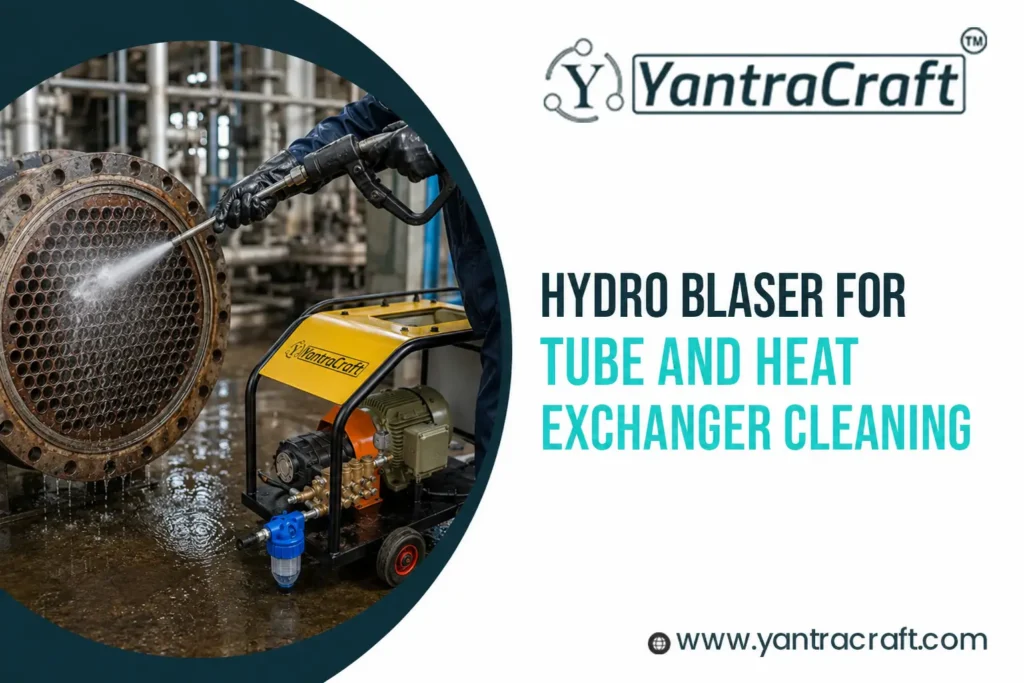
Quick Summary: Fouled heat exchanger tubes quietly waste fuel, cut output and force unplanned shutdowns. Here is how a hydro blaster restores them to full efficiency using nothing but high-pressure water.
Heat exchangers play an important role across diverse industries. Refineries, fertilizers, power plants, sugar mills, food processing lines, chemical and pharma units all rely on heat exchangers to transfer heat efficiently. But over months of running, the tubes slowly fill with scale, sludge, corrosion and process deposits. As this fouling builds up, heat transfer drops, and the plant burns more fuel or power to do the same job.
Left too long, fouled tubes lead to higher energy bills, lower output, higher pressure drop and even unplanned shutdowns. Regular cleaning is the answer, and today, the most effective, tube-safe way to do it is hydro blasting. This guide explains why tubes foul, how a hydro blaster cleans them, and how to choose the right machine.
What is a Hydro Blaster?
A hydro blaster is a machine that cleans using ultra-high-pressure water. Water is pressurised by a heavy-duty pump and forced through a specialised nozzle, hitting the surface hard enough to strip away even hardened deposits without any chemicals or abrasives. A hydro blasting machine pressure is measured in Bar and the water volume in LPM (litres per minute).
Why Heat Exchanger Tubes Get Fouled?
- Mineral Scale: hard, chalky layers from cooling water and hard water, one of the most common problems in India.
- Sludge & Mud: soft deposits that settle inside tubes and reduce flow.
- Corrosion & Rust: oxide layers that block heat transfer and roughen the tube surface.
- Coke & Carbon: hardened process deposits, common in refineries and petrochemical units.
- Biological Growth: algae and slime in cooling-water systems.
- Process Residue: polymer, salts and product build-up specific to the plant.
How Hydro Blasting Cleans Tubes & Heat Exchangers?
A powerful hydro blaster pressure washer is a systematic process. It cleans tubes and heat exchangers in the following steps:
- Isolate & Open the Exchanger: The unit is shut down, isolated and opened during a maintenance shutdown or turnaround so the tube bundle can be accessed.
- Inspect & Select the Tooling: The type and hardness of the deposit and the tube size decide the pressure, and whether a rigid lance (for straight tubes) or a flexible lance (for U-tubes and bends) is used, along with the right nozzle.
- Blast Tube Interior: The lance is fed through each tube while high-pressure water strips the deposit off the inside wall (tube-side / ID cleaning), restoring the tube to a clean metal surface.
- Clean the Shell Side & Bundle: External surfaces, the tube bundle and shell-side deposits are washed down using industrial water blasting equipment nozzles suited to the geometry.
- Flush, Inspect & Reassemble: Loosened scale and debris are flushed away, and the tubes are inspected for cleanliness, and the exchanger is reassembled, ready for service.
The Benefits of Hydro Blasting for Tube and Heat Exchanger Cleaning
- Restored Heat Transfer: Clean tubes bring the exchanger back to peak thermal performance.
- Lower Fuel & Power Cost: The plant stops over-spending energy to overcome fouling.
- No Chemicals: Nothing hazardous to store, handle or dispose of, an eco-friendly clean.
- No Tube Damage: Water removes the deposit without cutting into the metal.
- Longer Equipment Life: Less corrosion and stress on tubes and the exchanger.
- Faster Turnarounds: Efficient cleaning helps shutdowns finish on time.
Industries That Use Hydro Blasting for Heat Exchanger Cleaning
Hydro blasting is widely used in:
- Oil & Gas Refineries
- Petrochemical Plants
- Power Plants
- Fertilizer Plants
- Sugar Mills
- Chemical Processing
- Pharmaceutical Manufacturing
- Food & Beverage Processing
- Paper & Pulp Mills
- Steel Plants
Choosing the Right Hydro Blaster
The right hydro blasting systems depend on the deposit, the tubes and the site. Key points to consider:
- Pressure (Bar): Soft sludge cleans at lower pressure; hard scale, coke and corrosion need higher pressure.
- Water Flow (LPM): Higher flow speeds up removal and flushing on large bundles.
- Lance & Nozzle: Rigid lances for straight tubes, flexible lances for U-tubes and bends, and rotating nozzles for even, all-around cleaning.
- Frame Material: Mild steel for general use, stainless steel for corrosion-prone or hygienic environments.
- Motor or Engine: Electric drive for in-plant use, petrol/diesel engine pressure washer for remote sites without power.
YantraCraft builds hydro blasting systems from 150 up to 800 Bar with a flow of 15–30 LPM, powered by a heavy-duty triplex plunger pump, in electric or engine-driven versions with MS or SS frames. The range is designed exactly for heavy-duty hydro blasting to heat exchangers, condensers, reactors and surface preparation alike. Call us today to discuss your cleaning requirements.
Frequently Asked Questions
What pressure is needed to clean heat exchanger tubes?
It depends on the deposit. Soft sludge and light scale clean at the lower end, while hard scale, coke and heavy corrosion need higher pressure. YantraCraft hydro blasting systems cover 150 to 800 Bar with a flow of 15–30 LPM, so the pressure can be matched to the fouling and the tube material
Does hydro blasting damage the tubes?
No, when the correct pressure and nozzle are used by a trained operator. Water blasting removes the deposit without cutting into the tube wall — unlike drilling or aggressive rodding, which can scratch or thin the tubes. That is why it is preferred for cleaning heat exchangers and condensers.
How is hydro blasting better than chemical cleaning?
Chemical cleaning needs hazardous chemicals, careful handling and safe disposal of the used solution, and it can corrode equipment over time. Hydro blasting uses only water, nothing to store, handle or dispose of, and it physically removes the deposit rather than dissolving it, giving a thorough, eco-friendly clean.
What is the difference between hydro jetting and hydro blasting?
The idea is the same, cleaning with high-pressure water,r but hydro jetting usually runs at lower pressure for drains, sewers and pipelines, while hydro blasting runs at higher pressure for hard scale, tube and heat exchanger cleaning, and surface preparation such as paint and rust removal.