
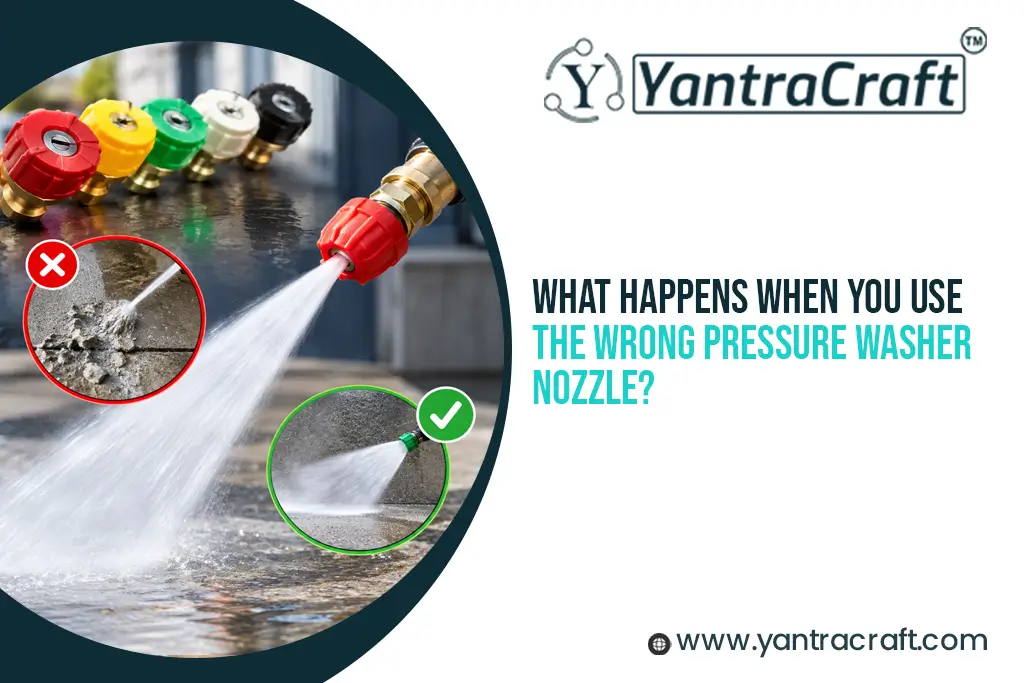
Most pressure washer problems that land on a service technician's bench don't start in the pump or the motor. They start at the tip of the gun, in a nozzle that costs a few hundred rupees.
The nozzle decides how all the pump's power reaches the surface. Pick the wrong one and you can etch concrete, strip car paint, overload the pump or simply waste an hour spraying without getting anything clean. This guide explains what goes wrong, how to spot it and how to choose correctly.
For industrial cleaning applications, Yantracraft provides pressure washer solutions where the right nozzle, pressure and flow need to work together for consistent cleaning performance.
Quick Answer: Using the wrong pressure washer nozzle causes one of two problems. A nozzle that's too narrow or too small concentrates too much force, which can damage surfaces, overload the pump and wear out seals. A nozzle that's too wide or too large drops the pressure, so cleaning becomes slow, weak and wasteful. The right nozzle matches both the machine's rated pressure and flow and the surface being cleaned.
What Happens When You Use the Wrong Pressure Washer Nozzle?
Using the wrong pressure washer nozzle can cause either excessive surface impact or poor cleaning performance. A nozzle with an unsuitable orifice can affect the pressure and flow delivered by the machine, while an unsuitable spray angle can concentrate the water too aggressively or spread it too widely. Choosing the nozzle according to the pressure washer's rated pressure, flow rate, orifice size and the surface being cleaned helps maintain effective and controlled cleaning.
Two Ways a Nozzle Can Be "Wrong"
Most people only think about spray angle. There are actually two separate things to get right.
1. Spray Angle
The angle controls how widely the water spreads. A narrow angle hits a small spot very hard, while a wide angle covers more area with less force per square inch.
2. Orifice Size
This is the diameter of the hole in the tip, usually stamped as a number on the nozzle. It controls how much water passes through at a given pressure. A 200 bar pressure washer only reaches 200 bar at the tip if the orifice is sized to match its pump. Get this wrong, and even the right angle won't save you.
Common Nozzle Angles and What They're For
Many manufacturers follow a colour code, though you should always check your own machine's nozzle chart.
| Angle | Common Colour | Best For | Risk if Misused |
| 0° | Red | Pinpoint removal of stuck deposits | Gouges wood and concrete, cuts rubber, injures skin |
| 15° | Yellow | Paint stripping, heavy grime on hard surfaces | Etches soft surfaces, damages car paint |
| 25° | Green | General cleaning of vehicles, machinery, floors | Slow on caked mud |
| 40° | White | Rinsing, delicate surfaces, glass | Too weak for grease or heavy dirt |
| Soap / low pressure | Black | Applying detergent | Won't clean on its own |
| Rotary / turbo | - | Heavy dirt over large areas | Too aggressive for paintwork |
What Happens When the Angle Is Wrong
Too Narrow: Surface Damage
This is the classic mistake. An operator can't shift stubborn mud, switches to a 0° or 15° tip and moves in close. The mud comes off, but so does the paint.
On concrete, a narrow jet leaves visible lines and etched streaks. On vehicles it can lift clear coat, tear rubber seals and force water past bearings and electrical connectors. On machinery, it drives water into motors and control panels.
Too Wide: Slow and Wasteful Cleaning
A 40° tip on caked mud or grease just slides over the surface. The operator keeps spraying, water use climbs and the result is still patchy. It's not dangerous, but it's expensive in time and water, especially at a busy commercial car wash pressure washer bay.
What Happens When the Orifice Size Is Wrong
This is where the machine itself starts to suffer.
Orifice Too Small: Stress on the Pump
A smaller hole restricts the water. Pressure builds beyond what the system is designed for, and the unloader valve keeps bypassing water back to the pump. That means:
The unloader wears out early from constant cycling
Pump seals and valves run hotter and fail sooner
The motor draws extra current, which can trip breakers or overload an electric motor
Engine-driven machines labour and burn more fuel
In short, a too-small nozzle shortens the life of an expensive industrial pressure washer to save nothing at all.
Orifice Too Large: Pressure Drop
A bigger hole lets water escape too easily. The pump delivers its full flow, but pressure at the tip falls well below the rating. The spray looks strong but lacks cutting power, so the cleaning is weak however long you keep going. It rarely damages the machine, but it wastes almost every rupee of the pressure you paid for.
Worn Nozzles: The Hidden Version of the Wrong Size
Every nozzle wears. High-velocity water, and especially sand or grit in the supply, slowly erodes the orifice and makes it bigger. A worn nozzle behaves exactly like one that's too large, with lower pressure, weaker cleaning and a distorted spray pattern.
A practical rule of thumb: when pressure has dropped noticeably, commonly around 10–15% below normal, or the spray fan looks uneven, replace the tip. On machines running a full shift every day, that can be every few months.
Warning Signs You're Using the Wrong Nozzle
The pressure gauge reads unusually high and the unloader chatters or cycles constantly
The electric motor trips or feels unusually hot
Cleaning suddenly takes much longer than it used to
Lines, stripes or etched marks appear on concrete
Paint, stickers or rubber trim come away during vehicle washing
The spray fan looks split, uneven or spits to one side
If you see any of these, check the nozzle before you call for a pump repair. It's often the cheapest fix available.
How to Choose the Right Nozzle
1. Start With the Machine
Check the rated pressure and flow of your pump, then use the manufacturer's nozzle chart to find the matching orifice size. A 150 bar car washer and a heavy duty pressure washer at 250 bar need different tips, even at the same spray angle.
Then Match the Surface
Cars and bikes: 25° or 40°, kept at a sensible distance
Trucks, buses and construction machinery: 25° or a rotary nozzle for caked mud
Workshop floors and concrete: 15° or 25°, or a surface cleaner attachment
Stuck-on deposits on steel: 15° or 0°, used carefully and never near people
2. Keep Distance and Technique Right
Start further away and move closer only if needed. Keep the wand moving, and never point any nozzle at a person.
3. Know When It's Not a Nozzle Problem
If you're reaching for a 0° tip every day to fight hard scale or cement build-up, the job has probably outgrown a pressure washer. That's the point to look at a hydro blasting machine designed for 300 to 500 bar work.
4. Get the Right Setup With Yantracraft
Yantracraft builds heavy duty pressure washer India for car washes, workshops, fleets and plants. The range covers 150 to 250 bar models, wall mounted pressure washer units for fixed wash bays, and diesel and petrol engine-driven machines for site work.
When you choose a Yantracraft machine, the team can help you match nozzles to your model and application. That way you get the full rated performance without straining the pump or damaging what you clean.
Explore the Yantracraft industrial pressure washer range, or contact the team through yantracraft.com for advice.
Conclusion
The nozzle is the smallest part of a pressure washer, but it has the biggest say in how the machine performs. Match the orifice to your pump, match the angle to the surface and replace worn tips on time. You'll clean faster, protect what you're washing and get years more life from your machine.
Frequently Asked Questions
Can the wrong nozzle damage my pressure washer?
Yes. A nozzle with too small an orifice raises system pressure, overworks the unloader and can overload the motor, which leads to early pump and seal wear.
Which nozzle is safest for washing cars?
A 25° or 40° nozzle used at a sensible distance is safest for car paintwork. Avoid 0° and 15° tips on vehicles.
How often should pressure washer nozzles be replaced?
Replace a nozzle when pressure drops noticeably or the spray pattern turns uneven. On daily-use industrial machines, that is often every few months.
Why is my pressure washer losing pressure?
A worn or oversized nozzle is one of the most common causes. Check the tip first before inspecting the pump, unloader or water supply.